
This Is What an AI-Enabled Director Assessment Looks Like

AI Does What 30 Years of Rating Scales Never Could.
The Director Confidence-Competence Gap
In an earlier post, I argued that standard governance assessments measure confidence, not competence. A director who rates themselves four out of five on risk oversight is telling you how they feel about their governance — not whether they are competent at doing it.
Spencer Stuart put a number on the competence gap: CEOs assessed their directors' competence 20 points lower than directors assessed themselves. AI is going to change that.
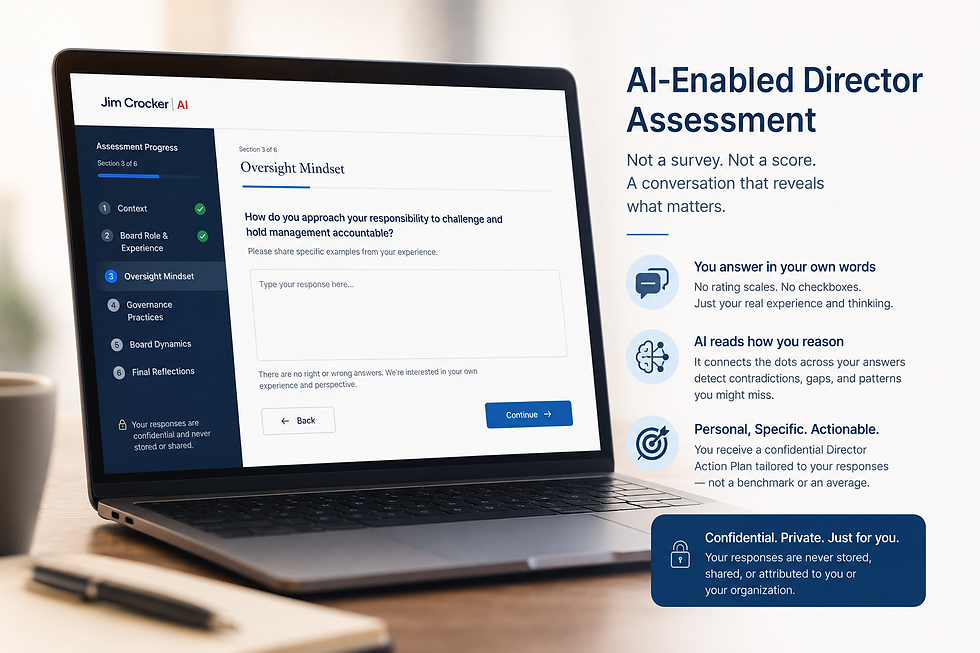
How this AI-enabled Director Assessment Works
It Reads how you reason — not what you score
Catches contradictions across your answers that are key but not obvious
Has no "N/A / Don't Know" option — you have to engage with every question
Calls out your blind spots specifically, based on your own words
Produces a confidential Director Action Plan — not a chart, not an aggregate, a diagnosis
You answer this self-evaluation in your own words. AI does what a skilled governance practitioner would do: listens for what's missing, what's thin, and what contradicts something you said three questions earlier. Then, it identifies the personal competence gap and recommends a plan for fixing it.
What it looks like in practice
Recently, a director completed the AI assessment. She identified that her Chair was too protective of the CEO and believed the board was handling strategy reasonably well.
AI surfaced something she hadn't seen: across three separate answers, she had given the CEO a ton of wiggle room on a strategic drift, relied on informal contacts for risk information, and accepted "working on a plan" as sufficient oversight. The AI assessor named the pattern directly, drawn entirely from her own words: "You are protecting the CEO without realizing it." No traditional scoring scale would have found that. And no aggregate report would have named it.
High Scores Don't Improve Governance.
The danger currently isn't that directors score themselves too generously. It's what happens when they do. A director who rates themselves 4 out of 5 on strategic oversight stops asking whether they actually understand the strategy well enough to challenge it. A board that scores well on CEO evaluation stops examining whether the evaluation process has any real teeth. High scores don't improve governance. They make the need for improvement invisible. As an experienced expert in the field, I saw this all the time.
Why Every Director Should Try This AI Self-Assessment
This assessment isn't perfect. It's an early version of something the governance industry has needed for a long time, and it will get sharper with use. But that's not the point. The point is what it demonstrates — that AI can do something in governance evaluation that no previous tool could: read how a director actually reasons, catch what's missing, and name what the director can't see in themselves.
That capability doesn't stop at board evaluation. The same AI that just read your reasoning about CEO accountability can be applied to strategy, planning, risk, recruiting, and operational oversight — and leading organizations are already doing it. Directors who understand what AI-enabled analysis actually feels like will ask better questions, push harder on management's assumptions, and recognize the difference between an organization using AI seriously and one using it for appearances. Directors who don't will be approving strategies they can't properly scrutinize.
Every director should understand what AI-enabled governance looks like — not because they need to become technologists, but because AI will reshape how organizations manage risk, how management presents to boards, and how oversight itself is being redefined.
This assessment is free. It takes fifteen minutes. Nothing is stored or attributed to you. Try it not because it's finished — but because every serious director should know what this feels like.
Jim Crocker has worked in governance for 25 years — as a CEO, board director, and advisor. He builds AI tools for boards.

Comments